

German Archaeological Institute (DAI Istanbul), German Archaeological Institute (DAI Istanbul)
22 Oct 09:30 - 18:30
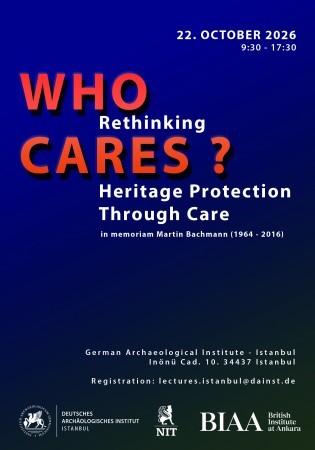
We are pleased to invite you to the workshop Who Cares? Rethinking Heritage Protection Through Care (In Memoriam Martin Bachmann, 1964–2016), taking place on 22 October 2026 at the German Archaeological Institute (DAI) in Istanbul, in cooperation with the Netherlands Institute in Türkiye (NIT) and the British Institute at Ankara (BIAA).
The event will explore the role of care in heritage protection and reflect on new approaches to the preservation of cultural heritage, while commemorating the life and legacy of Martin Bachmann (1964–2016).
Registration: Please register by emailing lectures.istanbul@dainst.de.
Heritage protection is commonly framed through normative and often prescriptive discourses that present the value of heritage as self-evident and broadly shared. Within such frameworks, the imperative to protect heritage can appear unquestionable, while the social, political, and emotional processes through which protection is enacted receive less attention. Yet heritage rarely has the capacity to endure on its own. Its survival depends on continuous acts of maintenance, stewardship, advocacy, repair, documentation, and negotiation—in short, on care.
Recent scholarship has increasingly turned to care as a productive framework for understanding heritage. Rather than treating protection primarily as a technical, legal, or institutional matter, a perspective centred on care shifts attention from the heritage object itself to the relationships through which it is sustained. It foregrounds the often invisible forms of labour, responsibility, knowledge, emotion, and ethical commitment involved in maintaining heritage over time. At the same time, care is neither neutral nor universally shared. Different actors—including state institutions, local communities, researchers, activists, property owners, and international organisations—may hold competing understandings of what constitutes appropriate care, who is responsible for it, and what futures heritage should be preserved for. Care can therefore become a site of tension, disagreement, and negotiation.
This workshop explores the multiple meanings, practices, and politics of heritage care. Bringing together scholars from archaeology, anthropology, geography, law, heritage studies, and related disciplines, it asks: Who cares for heritage? How is care conceptualised and enacted? What forms of labour does heritage care depend upon? How are responsibilities distributed between institutions and communities? Who has the authority to decide what constitutes appropriate care? And what conflicts emerge when different actors claim responsibility for, or authority over, the same heritage?
The workshop also asks whether care and protection should necessarily be understood as synonymous. Does caring always mean preserving? Can care involve adaptation, transformation, or even letting go? Can attempts to protect heritage sometimes undermine other forms of care? By approaching heritage protection through care, the workshop seeks to open up these tensions and consider what becomes visible when attention shifts from the preservation of heritage objects to the relationships, practices, and responsibilities that enable heritage to endure.
The workshop will combine theoretical reflections on care with empirical perspectives from Türkiye. Particular attention will be given to the role played by foreign research institutes operating in Türkiye, including the German Archaeological Institute (DAI), the Netherlands Institute in Turkey (NIT), and the British Institute at Ankara (BIAA). Through their long-standing involvement in archaeological research, conservation, documentation, and public engagement, these institutions provide valuable perspectives on the practical and ethical dimensions of caring for heritage across cultural, institutional, and national boundaries. Their own histories and practices also raise questions about how responsibility for heritage is negotiated between international research institutions, the Turkish heritage administration, local communities, researchers, and other actors.
Martin Bachmann was the second director of the German Archaeological Institute – Istanbul (2006–2016) and was closely involved in heritage conservation projects including Oinoanda and Pergamon. His work reflected a particular concern not only with the interpretation and understanding of heritage, but also with its long-term preservation through sustained care, maintenance, and the continuation of craft traditions. His approach resonates strongly with the questions at the heart of this workshop: who takes responsibility for heritage, what forms does that responsibility take, and how can care be sustained across generations and institutional boundaries? The workshop is held in memory of his work and his contribution to the long-term care of Türkiye’s multi-layered heritage.
Invited speakers | 09:30–12:45
09:30–09:45 Welcome and introduction
09:45–10:15 Claire Nolan : When no one seems to care: Heritage loss, cultural amnesia and deep stewardship in Ireland
10:15–10:45 Andreas Pantazatos : How do we care for the heritage of mental healthcare?
10:45–11:15 Marit van Dijk : When do ‘We Care Enough’? Rethinking Responsibilities in Heritage Work
11:15–11:45 Coffee break
11:45–12:15 Zaydoon Zaid : Who Cares for Yemen’s Heritage? From Emergency Protection to a Sustainable Culture of Care
12:15–12:45 Güldem Baykal Büyüksaraç : Forest as Heritage: Sacred Commons and Care Without Recognition
12:45-13:00 Discussion
The discussion will consider, among other questions:
What does it mean to approach heritage through care rather than protection?
What becomes visible when we focus on relationships, labour and responsibility?
Is care necessarily synonymous with preservation?
Who or what falls outside existing regimes of care?
13:00–14:15 Lunch
DAI – BIAA – NIT | 14:15–15:30
Rather than three separate institutional presentations, this session will take the form of a comparative discussion between the DAI, BIAA and NIT, with each institute bringing one or more concrete examples from its work in Türkiye.
The discussion will consider:
What does “care” mean in practice?
Who performs the work of caring for heritage?
What forms of visible and invisible labour does heritage care depend upon?
What tensions emerge between different understandings of care?
How have ideas and practices of care changed over time?
Who or what remains outside existing regimes of care?
What does it mean for an international research institute to care for heritage located within another country’s legal, institutional and cultural framework?
The session will also consider the three institutes themselves as sites through which different institutional histories, responsibilities, relationships, and understandings of heritage care can be explored.
15:30–16:00 Coffee break
Roundtable discussion | 16:00–17:30
Participants:
Invited speakers
Representatives of DAI, BIAA and NIT
Representatives from the Turkish heritage administration
Representatives from relevant heritage organisations and other stakeholders
The roundtable will bring together the perspectives developed throughout the day and consider how responsibility for heritage might be distributed between the state, professional institutions, research organisations, local communities, property owners, activists, and other actors.
Questions might include:
Who should be responsible for caring for heritage?
Who has the authority to decide what constitutes appropriate care?
How should responsibilities be distributed between institutions and communities?
What happens when different actors have conflicting understandings of what should be preserved and for whom?
Can care provide an alternative or complement to conventional models of heritage protection?
What might heritage protection look like if care, rather than preservation alone, were placed at its centre?
18:30 Dinner for invited speakers