

We are pleased to announce the “SACRED ENCOUNTERS: Religious Interactions in the Aegean and Eastern Mediterranean from the Bronze Age to the Roman Imperial Period” symposium, which will be held in Istanbul on 4−5 March 2027, hosted by the Netherlands Institute in Türkiye (NIT), and will consist of two conference days in the ANAMED auditorium.
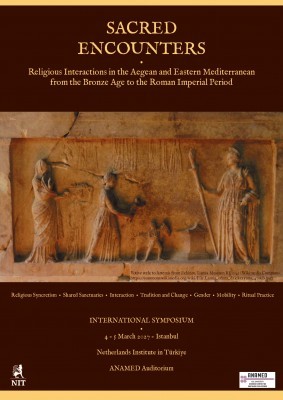
The ancient Aegean and Eastern Mediterranean formed a vibrant and multifaceted religious landscape, continuously shaped by centuries of cultural exchange, migration, and political transformation. Within this dynamic sphere, a diverse array of deities influenced everything from intimate domestic shrines to grand ceremonial sites and international religious networks. These gods and goddesses functioned not only as objects of veneration but also as active agents in forging identity, legitimizing authority, and binding communities across the ancient world.
This symposium invites scholars to explore how religion functioned and transformed across the interconnected regions of the ancient Aegean and Eastern Mediterranean—mainland Greece, the islands, Anatolia, Cyprus, Levant, and Mesopotamia. Chronologically, our scope stretches from the Bronze Age—when powerful deities were embedded in palace economies and redistribution systems—through the religious transformations of the Archaic period, the civic and intellectual dimensions of Classical religious life, the syncretic religious developments of the Hellenistic kingdoms, and the cosmopolitan religious pluralism of the Roman Imperial period. This broad geographical scope and longue durée perspective allow us to trace not only distinct religious traditions but also broader patterns of continuity, disruption, and renewal that characterized ancient religious life.
By integrating archaeological evidence with historical and epigraphic records and iconographic analyses, this symposium aims to examine how gods and goddesses actively shaped the social, political, and ritual life of ancient communities. We aim to move beyond static definitions of religion, gender, and divine identity. We welcome submissions that critically engage with the dynamic and contested nature of gender and power within ancient religious systems and that address the methodological challenges involved in studying religious change over broad temporal and geographic ranges.
Religious Syncretism and Cross-Cultural Interactions: What role did cross-cultural encounters play in transforming deities, rituals, and sacred spaces? This theme explores how deities were adopted, adapted, or reinterpreted across cultural and political boundaries. Rather than viewing syncretism as a passive blending of traditions, it examines how divine identities were reshaped to establish political authority, express cultural identity, and bring communities together across the changing Aegean and Mediterranean landscape.
Shared Sanctuaries: How did shared sacred spaces facilitate interactions not only between cohabiting deities but also among diverse human groups? This theme explores how people from different cultural, ethnic, and social backgrounds engaged with one another and with the divine within the same sacred landscape. Moving beyond literary sources, it focuses on the archaeological evidence—such as votive offerings, inscriptions, architectural modifications, and ritual remains—to reconstruct the material reality of multi-cultural religious life.
Tradition and Change in Cult Practice: How did religious beliefs and practices respond to periods of transition? This theme investigates the ways long-standing traditions were maintained or adapted to new social settings from the Bronze Age to the Roman Imperial period. It uses material evidence—like architectural continuity and shifting votive practices—to track how Aegean and Mediterranean religious rituals were either preserved or evolved (and how?) alongside historical changes.
Gender and Social Agency: How did religious systems affect social hierarchies, gender roles, and embodied experiences? This theme analyzes how the attributes and myths of deities reflected, reinforced, or challenged social structures, while exploring how shifting religious landscapes—including the introduction of new deities and evolving rituals—impacted or transformed gender-specific roles in social life.
Traveling Deities, Heroes, and Myths: How did the movement of people shape the sacred landscape of the ancient Aegean and Mediterranean? This theme examines how travelers, settlers, migrants, and local populations used the visual language of myth to negotiate coexistence, friction, and identity across maritime networks. By tracking the mobility of divine iconography and heroic visual motifs across different media, such as sculpture, glyptic, vase painting, coinage, and architectural relief—from local shrines to overseas colonies—we explore how visual expressions of power and community identity were transformed as “foreign” and “local” pantheons fused or competed through everyday religious interactions.
Take this opportunity to present your research: Each paper presentation will last 20 minutes, followed by a 10-minute discussion. We look forward to your insights and engagement.
• Proposals from scholars at all career stages, including advanced graduate students, are welcome.
• Submit your abstracts of no more than 300 words, accompanied by a brief biography, by 1 September 2026 to be considered.
• Send your proposal as a Word document to Gülşah Günata (gulsah.gunata@nit-istanbul.org) and İpek Dağlı Henry (ipek.dagli@istanbul.edu.tr). Use “Your name – SES 2027 – Paper Proposal.” as your subject line.
• Please indicate under which theme your proposal falls.
• Accepted papers will be notified by 30 September 2026.
• Please make sure your full name, affiliation, and contact details are included in the email.
• Selected papers may be considered for publication in an edited volume.
• Attendance at the workshop is free of charge, but registration is required.
• Participants of the Annual Meeting are kindly asked to cover their own travel costs, accommodation, and meals. Coffee/tea and refreshments will be provided by the NIT during the conference days.
• The language of the symposium is English.
• The workshop will be in-person with no livestream.
• Although not guaranteed at this point, self-funded PhD students/candidates and unwaged independent scholars may apply for funding to cover part of their expenses. Please indicate your intention to apply for support when you submit your abstract and check with us after the announcement of the selected papers.
Gülşah Günata (Netherlands Institute in Türkiye)
İpek Dağlı Henry (Istanbul University)
Fokke Gerritsen (Netherlands Institute in Türkiye)
Aysel Arslan (Netherlands Institute in Türkiye)
Gülşah Günata (gulsah.gunata@nit-istanbul.org)
İpek Dağlı Henry (ipek.dagli@istanbul.edu.tr)