

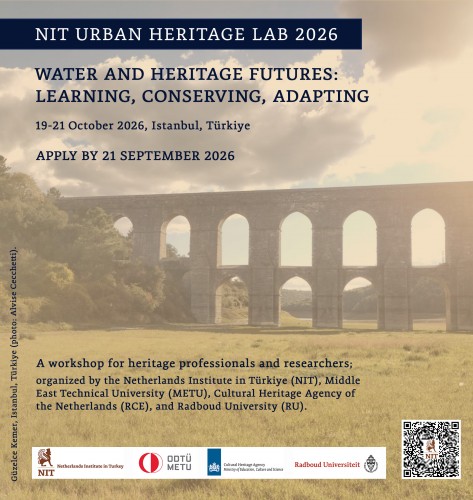
A workshop for heritage professionals and researchers, organized by the Netherlands Institute in Türkiye (NIT), Middle East Technical University (METU), Cultural Heritage Agency of the Netherlands (RCE), Radboud University (RU) 19-21 October 2026, Istanbul, Türkiye
The Water and Heritage Futures program brings together heritage professionals and researchers to explore the multiple relationships between water and heritage. The program includes invited talks, field visits, workshops, and discussion sessions, creating a platform for comparative exchange between different disciplinary, professional, and geographical perspectives.
The Water and Heritage Futures program has a transdisciplinary setup and is open to academic researchers (including PhD candidates), heritage professionals and representatives of governmental institutions and non-governmental organizations who are active at the intersection of water and heritage, and interested in sharing their experiences, learning from others working on the relationships between water and heritage, building their international network, and exploring possibilities for future collaborative projects.
The Water and Heritage Futures program takes place at the Netherlands Institute in Türkiye in Istanbul. There are 25 places available and participants will be selected based on their interests, disciplinary/professional background, and involvement in ongoing projects.
The program focuses on three interconnected themes:
Heritage provides a valuable lens for understanding the long-term relationships among water, societies, cities, and landscapes. Historic settlements, infrastructures, ports, waterfronts, agricultural systems, reservoirs, fountains, wetlands, and cultural practices reveal how communities have lived with water, managed its scarcity or abundance, and shaped their environments accordingly. Contributions under this theme may examine how tangible and intangible water-heritage traces help us better understand present-day spatial, environmental, and social conditions.
Heritage places, landscapes, buildings, archaeological sites, and cultural practices are increasingly affected by water-related threats such as flooding, sea-level rise, coastal erosion, drought, humidity, groundwater changes, pollution, and extreme weather events. These pressures may cause physical damage, but they may also transform heritage values, patterns of use, community attachments, and institutional responsibilities. Contributions under this theme may focus on documentation, protection, risk assessment, preventive conservation, adaptive management, governance, and community-based responses to changing water conditions.
Heritage is not only something to be protected from water-related risks; it can also contribute to future-oriented responses to water challenges. Historic water management systems, traditional ecological knowledge, landscape practices, settlement patterns, maintenance cultures, and community-based forms of care may offer insights for climate adaptation, water-sensitive planning, risk awareness, and sustainable development. Contributions under this theme may explore how heritage knowledge and values can inform contemporary solutions by connecting technical and environmental approaches with cultural memory, local knowledge, public engagement, and long-term responsibility.
12 October, Monday, 14:00-16:00 | Online Preparatory Meeting
19 October, Monday at NIT | Framing Water and Heritage
Part 1: Introductions, Pitches and Posters
Participants will briefly introduce their work through short pitches and a poster session. Each participant will be expected to bring a small-format poster presenting their research, project, or practice-based experience to the group.
Part 2: Workshop 1 - Mapping Relationships Between Water and Heritage
Moderators: Fokke Gerritsen (NIT) and Mariëtte Verhoeven (RU)
Part 3: Field Trip Exploring Water and Heritage in Istanbul
20 October, Tuesday at NIT | Challenges, Adaptation, and Future Possibilities
Part 4: Invited Talks
Speakers include:
Jean Paul Corten (RCE),
Lotte Zaaijer (RCE),
Suzanne Loen (LILA Living Landscapes),
Meisha Hunter (President, ICOMOS ISC Water and Heritage),
Figen Kıvılcım Çorakbaş (Uludağ University, Prof. Dr.; Member, ICOMOS ISC Water and Heritage)
Part 5: Workshop 2 - Heritage Under Water-Related Pressure
Moderators: Özgün Özçakır (METU) and Alvise Cecchetti (NIT)
Part 6: Brainstorm Sessions in Three Groups
21 October, Wednesday at NIT | Reflections and Collaborations
Part 7: Group Presentations
Part 8: Final Discussion and Next Steps
1 November, Sunday | Submission of Group Findings
If you are interested in participating, please apply by September 21 by filling out this form https://forms.gle/LAbVmEmm8WFpNXtw7. Applicants will be notified of the results by the end of September. Applications by candidates that can only participate in part of the program will not be considered.
The workshop is primarily designed for academic researchers and PhD candidates, heritage professionals and representatives of governmental institutions and non-governmental organizations that are active at the intersection of water and heritage, based in the Netherlands or Türkiye. Interested individuals from other countries are also encouraged to apply, but may not be given priority.
The language of the workshop is English. There is no registration fee, but participants are expected to cover their own costs for travel, accommodation, and meals. Please note that the organizing institutions cannot offer assistance with visas for Türkiye.
Participants are also invited to attend the one-day international symposium “Who Cares? Rethinking Heritage Protection Through Care,” co-organized by NIT, the British Institute at Ankara, and the German Archaeological Institute in Istanbul, on October 22. More information about this symposium will be posted at the website.
The Netherlands Institute in Türkiye conducts and supports scholarly research on Türkiye through the ages. Part of Leiden University, it stimulates academic and transdisciplinary collaboration between the Netherlands and Türkiye, especially related to archaeology, history, and cultural heritage. Since 2021, it has organized a series of international research, education, and public engagement programs on cultural heritage, including water heritage and sustainability. See: https://www.nit-istanbul.org/publications
Middle East Technical University’s Graduate Program in Conservation of Cultural Heritage is a multidisciplinary program offering M.S. and Ph.D. degrees. Established in 1964, it was the first graduate program of its kind in Türkiye and has since played a leading role in conservation education, research and practice. The program brings together expertise in architectural and historic site conservation, historic building materials, heritage documentation and heritage information management, conservation policy, and the legal, administrative and economic dimensions of heritage protection. https://cons.metu.edu.tr/
The Cultural Heritage Agency of the Netherlands (RCE) is a department of the Ministry of Education, Culture and Science. It covers all tangible Dutch heritage (except for archives), ranging from archaeological finds (underground and underwater) to monuments (and sites), landscapes (urban and rural) and collections (and museums). RCE’s main challenge is to give relevance to heritage in an ever-changing society. It is commissioned to develop heritage policies, provide practical advice, and develop academic knowledge. This task is conducted in close cooperation with an extended heritage field.
Radboud University, Radboud Institute for Culture & History, Research Group Environmental Humanities, Project ‘Engaging with Istanbul’s Water Heritage’. One of the initiatives of the project is the Istanbul-SU web application https://istanbul-su.rich.ru.nl/, containing a database with metadata on Istanbul's historical water supply systems and the installations that were part of them such as aqueducts, cisterns, fountains, and baths. The Istanbul-Su research project aims to make knowledge about Istanbul's rich and multicultural water heritage available to both scholars and a wider audience.
Figen Kıvılcım Çorakbaş is Professor at Bursa Uludağ University Faculty of Architecture Department of Architecture. Her interests include site management, integrated conservation, interpretation and presentation of tangible and intangible qualities of urban heritage, archaeological and modern heritage sites, as well as narrative-based valorization of heritage sites. She is a member of ICOMOS Türkiye National Committee and actively involved in the ICOMOS International Scientific Committee on Water and Heritage (ISC Water).
Jean-Paul Corten obtained his degree in history at Utrecht University, and later studied planning. He started his career as a researcher in the history of technology at Eindhoven University. Currently he is employed as senior policy officer on Integrated Conservation at the Cultural Heritage Agency of the Netherlands (Ministry of Education, Culture and Science). Besides this, he is affiliated with the Institute for Housing and Urban Development Studies, Erasmus University of Rotterdam. He is involved in many urban regeneration projects abroad.
Lotte Zaaijer is a heritage advisor for historic buildings and areas at the Cultural Heritage Agency of the Netherlands, where she advises on heritage issues in the northern Netherlands. Before joining the Agency, she ran her own consultancy for building history research for ten years. With a background in both architecture and building history, she prefers to work at the intersection of research and design.
Meisha Hunter is the Director of Preservation and Planning at Li/Saltzman Architects. Her research interests focus on the nexus of traditional water & land management systems, stewardship & governance; SDG6 targets & climate change adaptation. She serves as President of ICOMOS' International Scientific Committee on Water & Heritage and Honorary Representative of ICOMOS' SDG Working Group. She is a Fellow of the American Academy in Rome & a member of the American Institute of Certified Planners.
Suzanne Loen is a landscape consultant working on research, designs and strategies for sustainable healthy cities and landscapes in various inspiring collaborations. Loen has a special focus and expertise in co-creative green healthy city development and (re-)creating value for sensitive cultural and heritage landscapes, their water systems and ecology.